Solfeggio
Nine frequencies. What the tradition says and what physics says.
The Solfeggio frequencies are a nine-tone scale (174, 285, 396, 417, 528, 639, 741, 852 and 963 Hz) popularized in the 1970s from a numerological reading of a medieval hymn. They are not notes of any musical scale: almost none of them lands on a note tuned to A = 440. They are not "nature's frequencies" either. They are numbers picked by a modern tradition.
That doesn't make them useless. They are tones, and a tone is the simplest thing you can listen to: one frequency, no harmonics, no rhythm. Sitting with a tone is sitting with almost nothing. That is exactly why they work as an anchor: something simple and concrete to come back to.
On every card I keep the two things apart. "In the tradition it's associated with" is intention: the name the Solfeggio tradition gives the tone, and the map of energy centers from the poster the Cymatica presets were born from. "What shape it produces" is physics: what you see on the plate when that tone sounds, calculated, not interpreted.
Pick the one you want. Play it quietly. Watch.
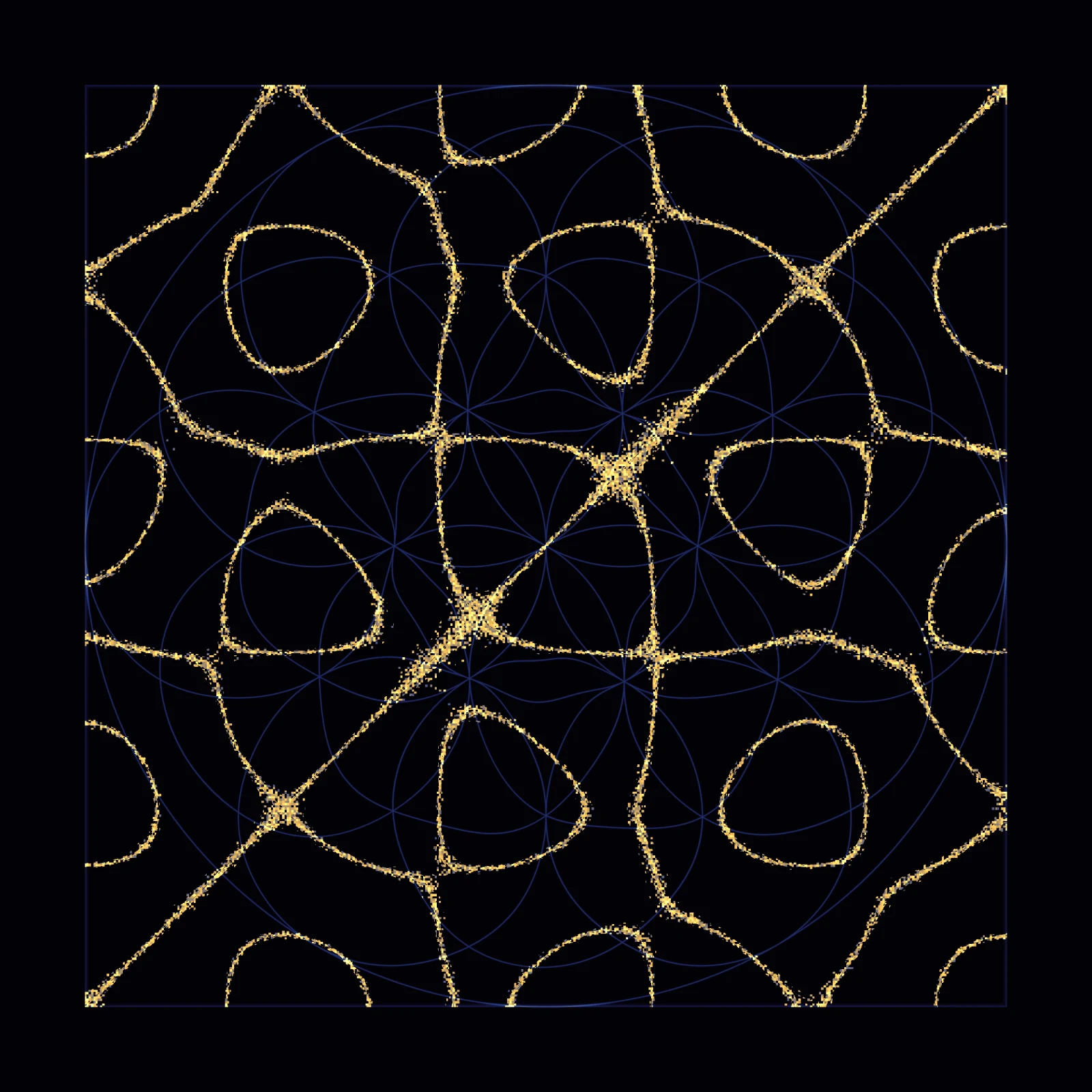
The nine Solfeggio frequencies in figures
| Hz | Tradition | Note | Cents | Path |
|---|---|---|---|---|
| 174 | Forgiveness | F3 | −6 | Level 1 · 5 min |
| 285 | Compassion | C#4 | +48 | Level 2 · 5 min |
| 396 | Root | G4 | +18 | Level 3 · 5 min |
| 417 | Sacral | G#4 | +7 | Level 4 · 8 min |
| 528 | Solar plexus | C5 | +16 | Level 5 · 8 min |
| 639 | Heart | D#5 | +46 | Level 6 · 8 min |
| 741 | Throat | F#5 | +2 | Level 7 · 10 min |
| 852 | Third eye | G#5 | +44 | Level 8 · 10 min |
| 963 | Crown | B5 | −44 | Level 9 · 10 min |
Tab. 01 · Nearest note and cents worked out with A = 440 Hz and equal temperament. A semitone is 100 cents.
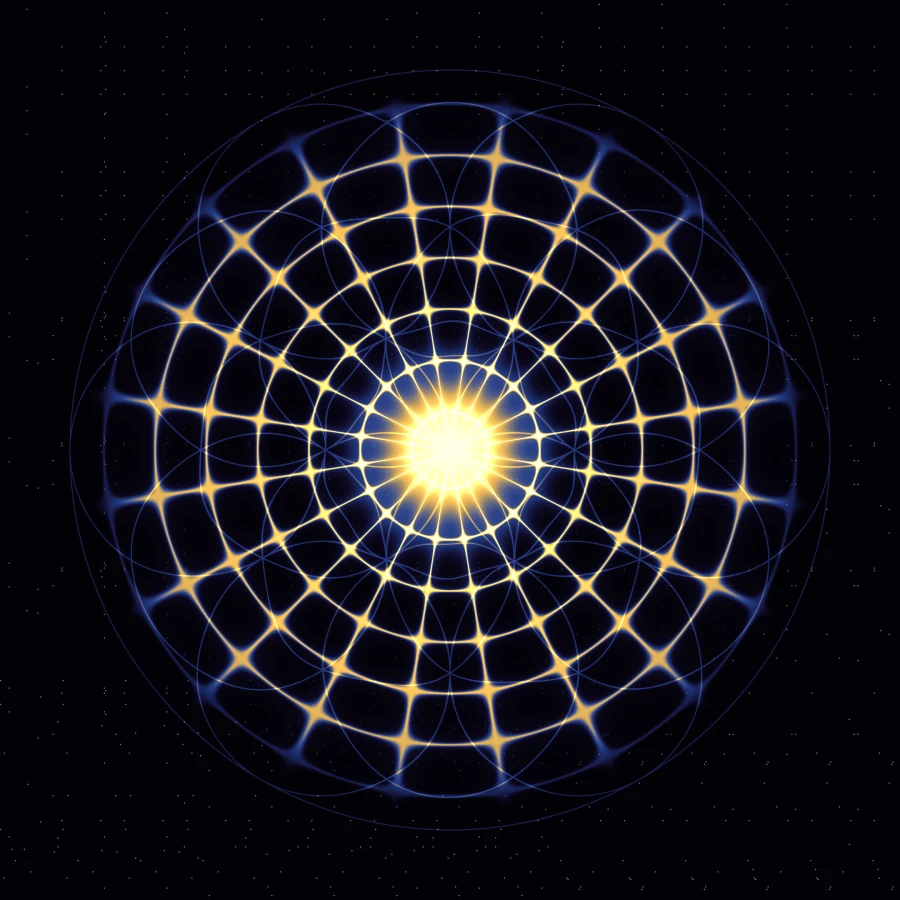
174 Hz · F3 −6¢
Forgiveness
In the tradition it is associated with
forgiveness and the ground. It's the lowest tone of the series and many people use it to open a practice: the first thing you hear, before any intention.
Suggested practice
Coherent 5-5 breathing (inhale 5 s, exhale 5 s). Water mode, Sand palette, Seed of Life layer. 5 minutes. It's level 1 of The Path.
What shape it makes
At 174 Hz the plate vibrates in one of its lowest modes: few nodal lines, large cells and a well defined cross or diamond at the center. In Water, a wide, slow ring. It's the simplest shape of the nine, and you can watch the whole thing move when you go up or down a single hertz.
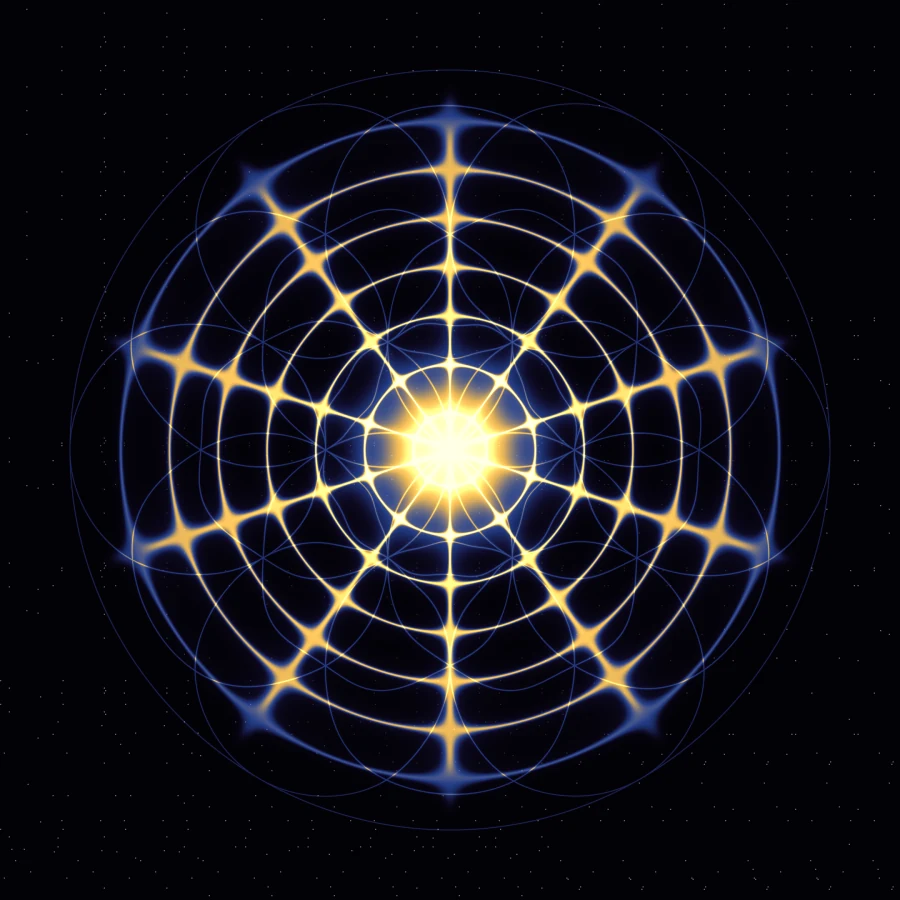
285 Hz · C#4 +48¢
Compassion
In the tradition it is associated with
compassion and taking care of yourself. On the poster's map it sits next to Forgiveness, outside the seven classic centers, as an entry tone.
Suggested practice
Coherent 5-5 breathing. Mandala mode, Ice palette, Vesica piscis layer (Pro) or Seed of Life (free). 5 minutes.
What shape it makes
Sitting between two notes, 285 Hz also falls between two modes of the plate, and Cymatica overlays them: you get a four-cell figure that never quite makes up its mind, with edges that breathe. It's one of the most unstable shapes of the series, and that makes it one of the best looking in Water.
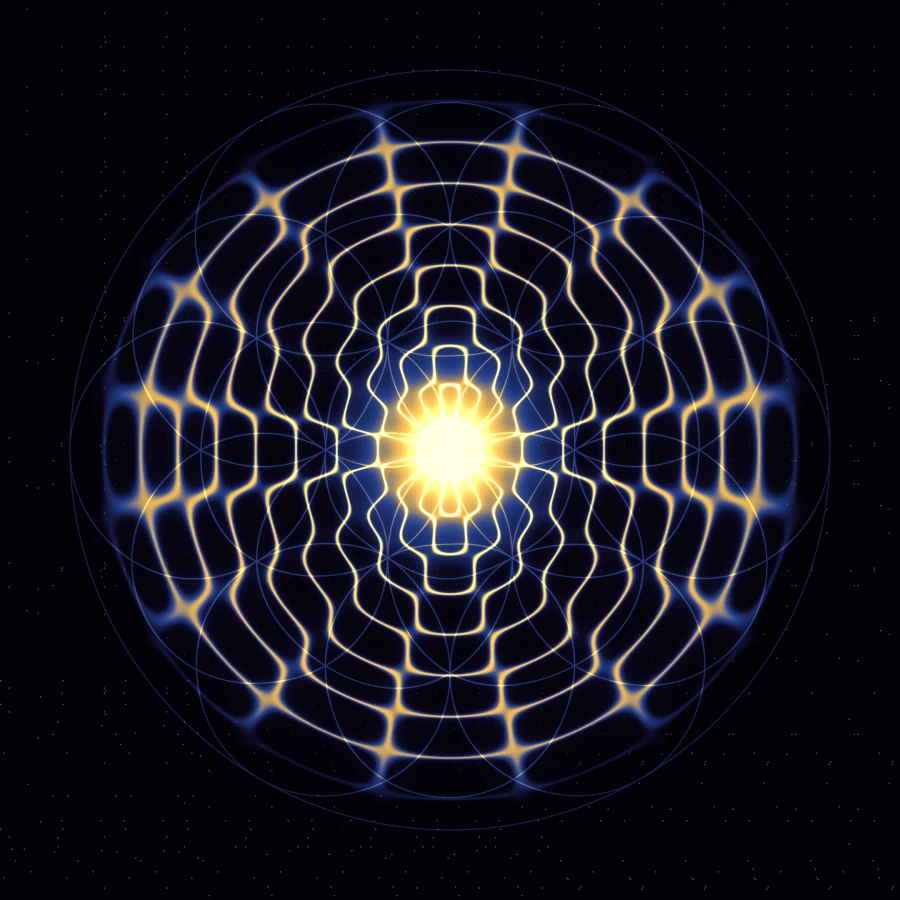
396 Hz · G4 +18¢
Root
In the tradition it is associated with
the root, the base, what holds you up. It's the first of the seven centers on the map. Many people use it to accompany the moment of sitting down and noticing the weight of the body.
Suggested practice
Box breathing 4-4-4-4. Chladni mode, Sand palette, Cube · Earth layer (Pro) or Flower of Life (free). 5 minutes.
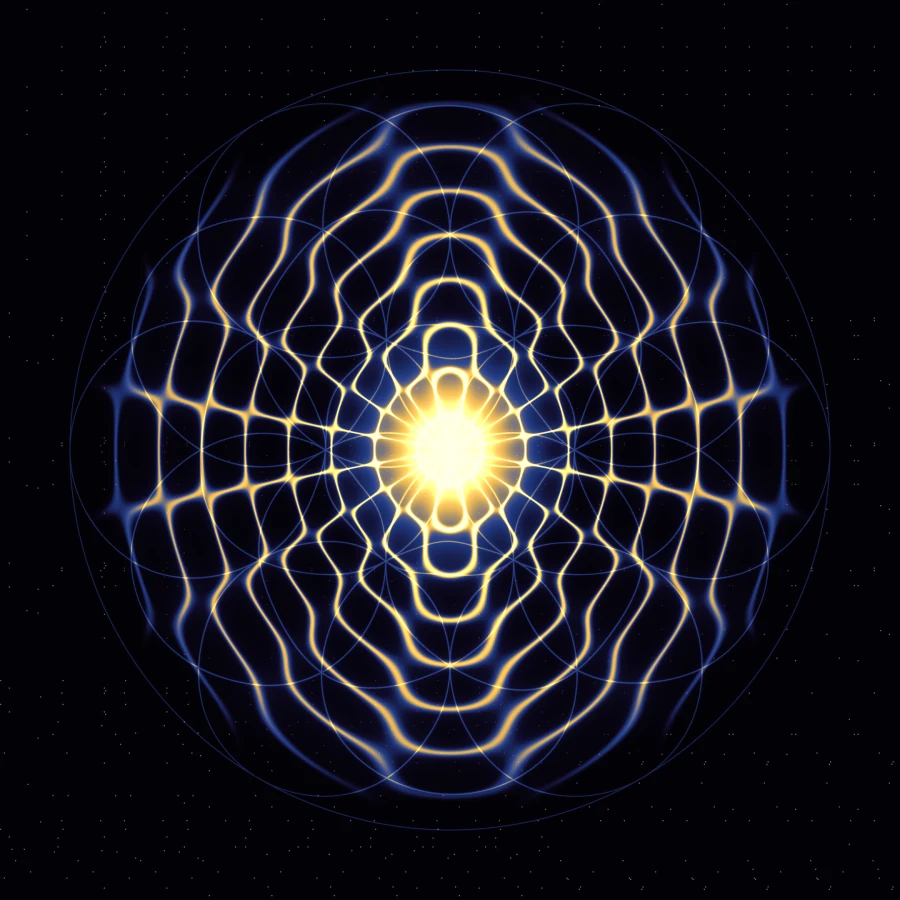
What shape it makes
A pattern of square cells, dense but readable, with four-fold symmetry. In Chladni it looks like a three by three grid with curved edges. It's the most architectural shape of the series: straight lines, corners, little movement.
417 Hz · G#4 +7¢
Sacral
In the tradition it is associated with
change, movement and the creative. On the poster's map it's the second center.
Suggested practice
Coherent 5-5 breathing. Water mode, Phosphor palette, Golden Spiral layer (free). 5 minutes. Push Detail up: at this frequency the relief of the water shows a lot.
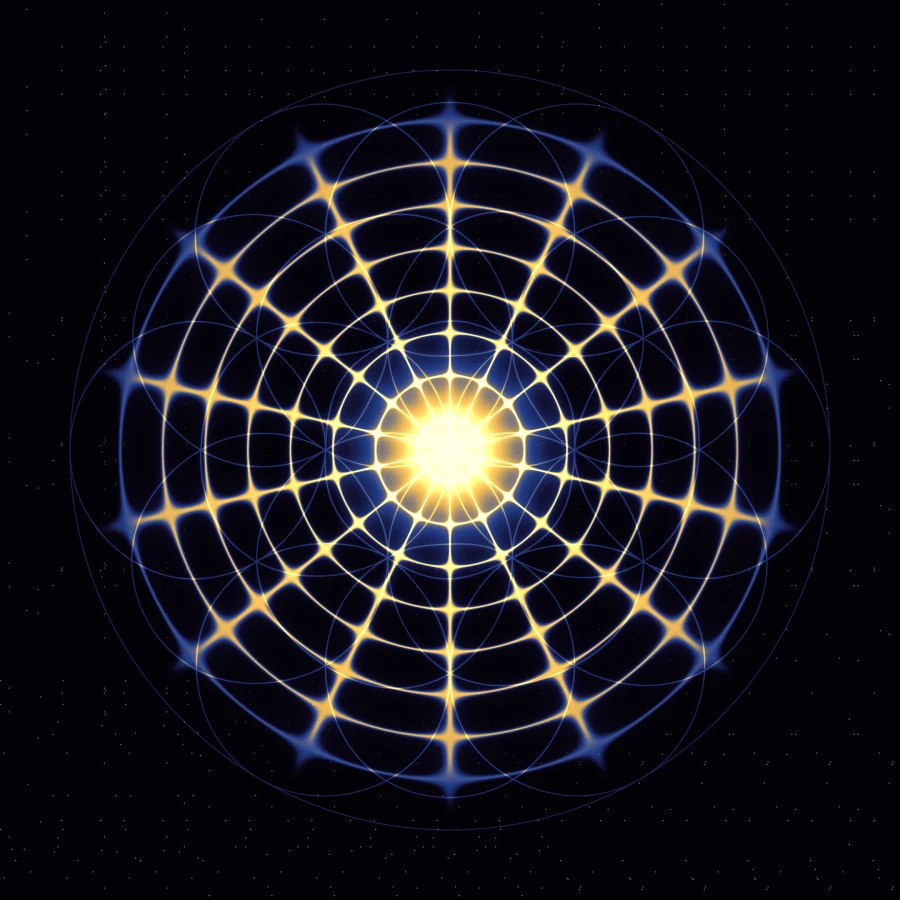
What shape it makes
One semitone above 396 and the plate jumps to a neighboring mode: the grid breaks into smaller cells with a marked diagonal. Play 396 and 417 back to back and you see the whole jump. It's the best example of how a small difference in Hz changes the shape completely.
528 Hz · C5 +16¢
Solar plexus
In the tradition it is associated with
transformation and the center. It's the best known of the nine, and the internet calls it many things. In Cymatica I call it by the name on the map: Solar plexus. Many people use it as their default tone to meditate, and it's the one playing in the hero of this site.
Suggested practice
Coherent 5-5 or 4-7-8 breathing. Chladni mode, Sand palette, Flower of Life layer (free). 5 to 10 minutes.
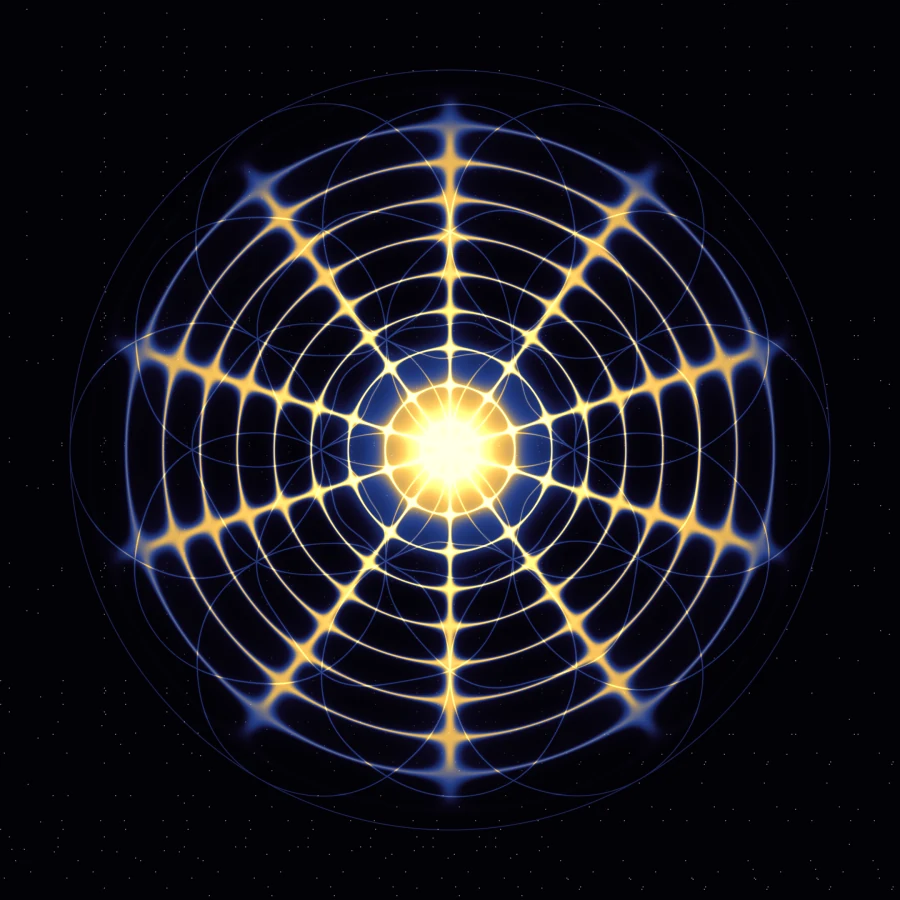
What shape it makes
Six-fold symmetry. At 528 Hz the plate draws a hexagonal star with an empty center and six petals, and that's why the Flower of Life layer sits on it so well: the intersections of the circles fall close to the nodal lines. It isn't a mystical coincidence. It's that both things have six-fold symmetry.
639 Hz · D#5 +46¢
Heart
In the tradition it is associated with
the heart, connection and relationships. Fourth center on the map, the one in the middle.
Suggested practice
Coherent 5-5 breathing. Mandala mode, Cosmos palette, Fruit of Life layer (Pro) or Flower of Life (free). 8 minutes.
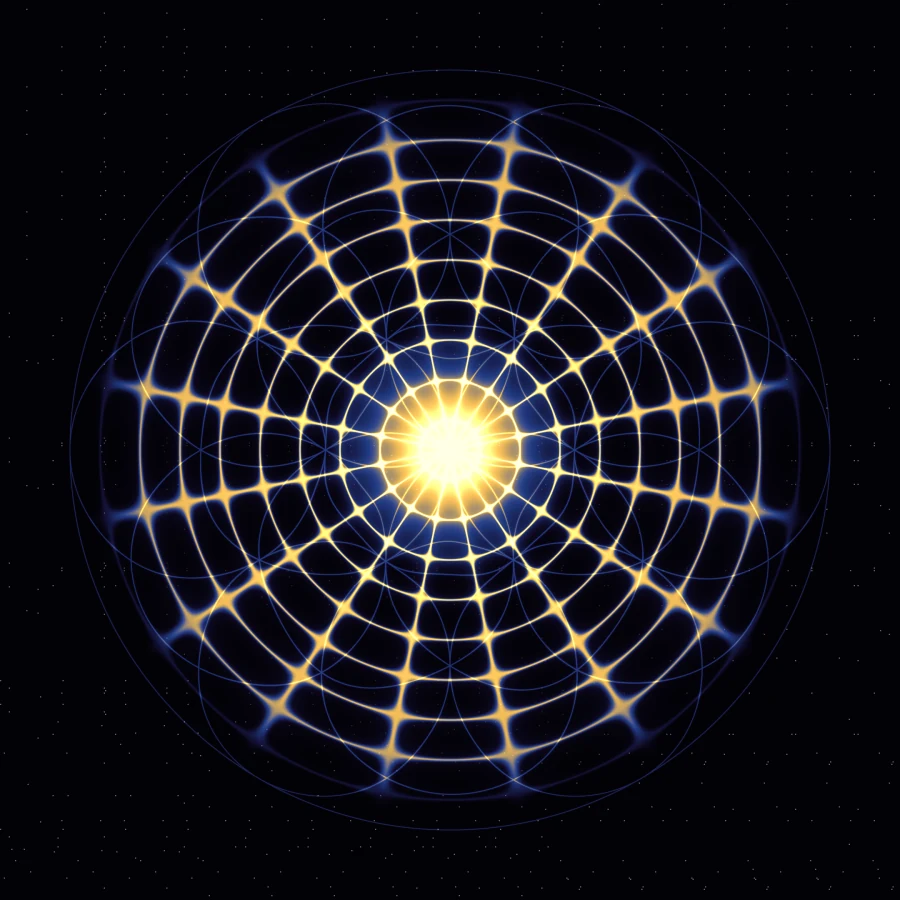
What shape it makes
In Mandala, three concentric rings crossed by twelve thin spokes, with a center that pulses. In Chladni, elongated cells that organize in two directions. Like 285, it sits between two modes and Cymatica blends them: the shape has a tremor that 528 and 741 don't have.
741 Hz · F#5 +2¢
Throat
In the tradition it is associated with
expression, the voice, saying what's there. Fifth center.
Suggested practice
Box breathing 4-4-4-4. XY mode with a 3:2 ratio (a fifth), White palette, Atom · Microcosm layer (Pro) or no layer. 8 minutes. If you sing or produce, try humming the note and watching the spectrum.
What shape it makes
In Chladni, a fine mesh of small cells with four-fold symmetry and an inner ring. In XY with a 3:2 ratio, a closed Lissajous curve of three lobes by two. It's the first frequency of the series where the shape starts to look woven.
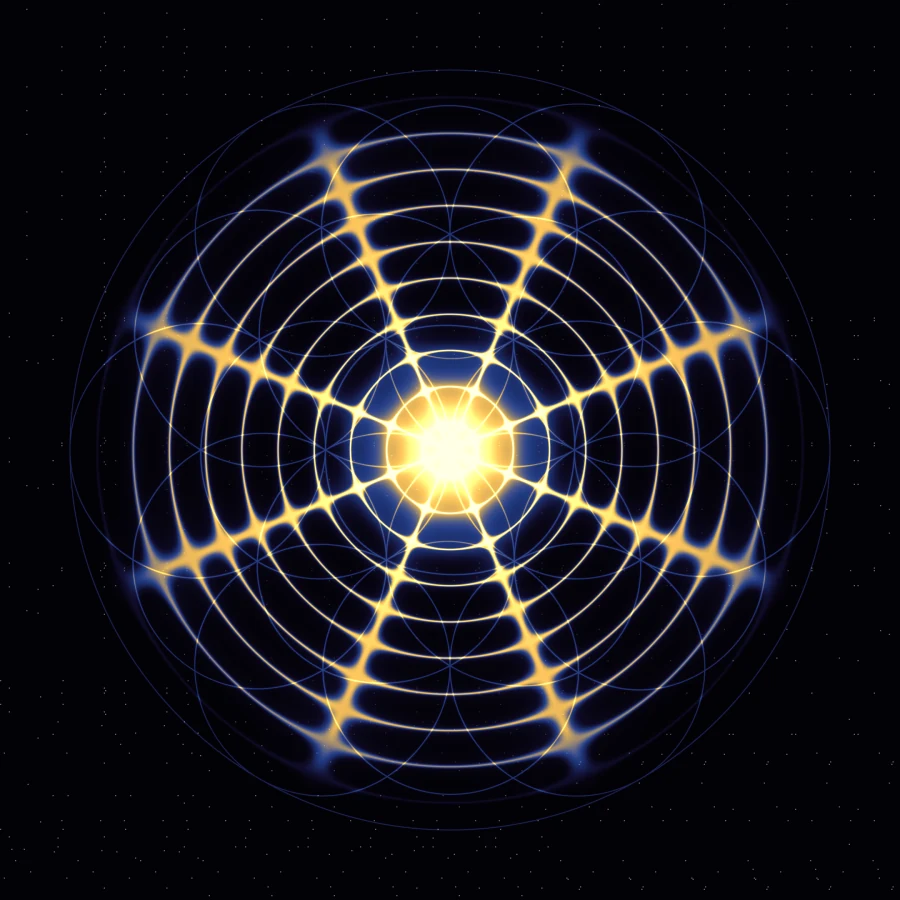
852 Hz · G#5 +44¢
Third eye
In the tradition it is associated with
intuition, clarity and seeing. Sixth center. On the poster it shares its frequency with Metatron's Cube.
Suggested practice
4-7-8 breathing. Chladni mode, Ice palette, Metatron's Cube layer (Pro) or Flower of Life (free). 10 minutes. Bring Detail down: this high up, less sand reads better.
What shape it makes
Six-fold symmetry again, but one mode higher than 528: the hexagon subdivides and twelve points appear with triangular cells inside. Metatron's Cube sits on top for the same reason the Flower sits on 528.
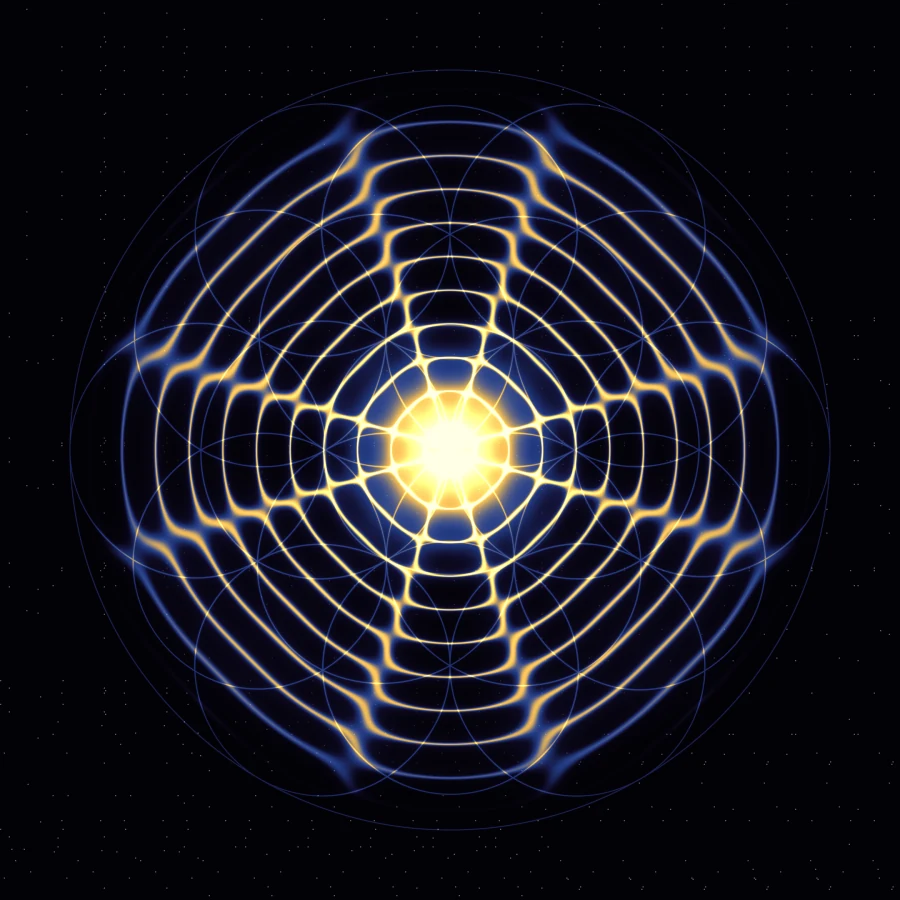
963 Hz · B5 −44¢
Crown
In the tradition it is associated with
unity, consciousness and closing. Seventh center, the last one on the map and the last level of The Path.
Suggested practice
Coherent 5-5 breathing, the simplest one, to close. Water mode, Cosmos palette, Tree of Life layer (Pro) or Seed of Life (free). 10 minutes. When you finish, bring the volume to zero before stopping the tone.
What shape it makes
The densest of the nine: a net of small cells with ten-fold symmetry that looks like lace in Chladni and like ordered foam in Water. It's the frequency where the precision of the detector shows most: at 963 Hz an error of a single hertz already changes the drawing.
Article
432 vs 440: what is history and what is convention.
Where 440 comes from. For centuries, every city and every orchestra tuned its own way. In the 18th and early 19th century, the A could run anywhere from 400 to 460 Hz depending on the organ, the country and the decade. In 1859 France fixed the "diapason normal" at 435 Hz by law. In 1885, a conference in Vienna adopted the same value. In 1936 the American Standards Association recommended 440 Hz, and in 1955 the ISO turned it into an international standard (ISO 16). 440 was chosen because it was a round number close to what was already in use, and because orchestras had been pushing the pitch up to sound brighter.
Where 432 comes from. If you define middle C as 256 Hz (a power of 2, convenient for 19th century physics and acoustics) and tune in pure fifths (Pythagorean tuning), the A comes out at exactly 432 Hz. Verdi, in 1884, backed fixing the A at 432 as an alternative to the French 435. That is the real history. What has no basis is the idea that 432 is "the frequency of the universe", or that 440 was imposed with bad intentions: the 1936 proposal and the 1955 standard are documented, and they are boring.
How much it changes. The difference between 440 and 432 is about 32 cents, less than a third of a semitone. It's audible if you compare the two tones back to back, and many people prefer the lower sound. Preferring something is legitimate. Claiming that one is "natural" and the other isn't, is not: both are conventions.
What Cymatica does. It gives you both: the Notes · A=440 group and the Notes · A=432 group, with the twelve notes of the middle octave in each tuning, and MIDI input in both. You can set C4 at 440, switch to 432 and see how the shape changes. It isn't much, and that's the honest part: a third of a semitone moves the nodal lines a little, it doesn't reinvent the drawing.
| A4 | 440.00 Hz |
| A4 | 432.00 Hz |
| Difference | 32 cents |
Tab. 02 · Less than a third of a semitone. Audible if you compare the two tones one after the other.
Article
φ is not a frequency. It's a ratio.
In sound, φ is an interval. Two tones with a 3:2 ratio make a perfect fifth; with 2:1, an octave. With a ratio of φ they make no known interval: φ is irrational, so the relation between the two waves never repeats exactly. In XY mode, Cymatica draws one tone against the other as a Lissajous curve. With 3:2 the curve closes into three lobes by two and holds still. With φ, the curve never closes: it turns slowly, fills the frame and never passes through the same place twice. That's what you hear too: a beating that never settles.
In Cymatica
- ·
Fibonacci · ratios: ten presets from 1:1 to 89:55 plus exact φ, all on 220 Hz. Put them in order in XY and watch the curve close more and more slowly until, at φ, it stops closing. From 21:13 on, the distance to φ drops below what the ear can tell apart, which is around 5 cents: 21:13 sits 2.84 cents from φ, 34:21 1.08, 55:34 0.41 and 89:55 0.16. They sound the same as φ and that is not a bug: the app tells you so under the preset name, and in XY you can still see the difference.
- ·
Fibonacci · frequencies: 89, 144, 233, 377, 610, 987, 1597 and 2584 Hz, with the Golden Spiral layer. They are numbers from the sequence used as hertz. Acoustically there is nothing special about them: they're a game, and I say so plainly.
- ·
Universal constants: φ, π, e and √2 as ratios. All irrational, all curves that never close, each with its own character.
Phyllotaxis. The seeds of a sunflower are placed one after another turning 137.5°, the golden angle (360° divided by φ²). It's the way to spread points on a disc without empty rows forming. Cymatica's Sunflower (phyllotaxis) layer draws exactly that pattern, and if you set the ratio to φ, the seeds redistribute by the golden angle. The pine cone (8:13) and the succulent (5) in the Nature group use the same layer with other numbers.
What I don't claim. That φ is "the divine proportion" is a reading, not a measurement. The nautilus, for example, has a logarithmic spiral, but not the exact golden spiral; the difference is visible if you measure it. In Cymatica the Nautilus preset uses the golden spiral because it's the one people look for, and I say it here so I'm not selling you a precision that doesn't exist.