Intention collection · Abundance and manifestation
Abundance frequencies. See them and hear them.
The Abundance and manifestation collection brings together six frequencies the tradition links to prosperity, gratitude and intention: 528 Hz, the love frequency, and 888 Hz, the number of abundance, plus 417, 639, 852 and 963 Hz. Each one plays with its golden pair: the same tone multiplied by φ, higher, in the other ear.
Six frequencies, six figures.
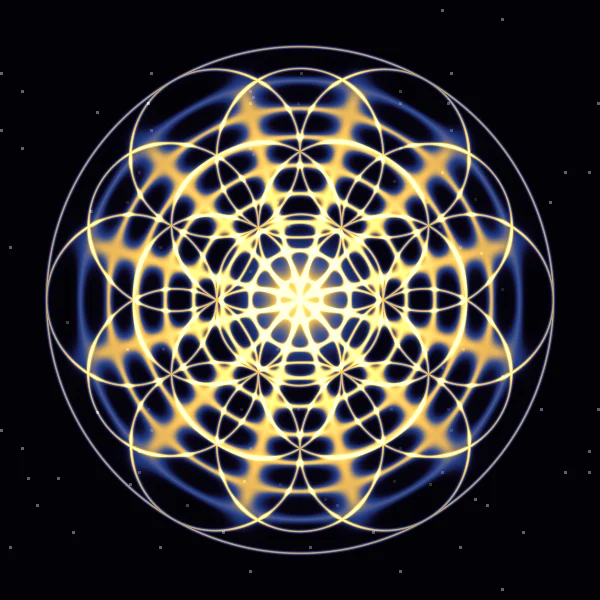
Manifest · 528 Hz · φ528 Hz + 854.3 Hz (× φ) 528 Hz, the frequency of love and transformation in the Solfeggio tradition, with its pair at φ and the Flower of Life. To start the day with a clear intention.
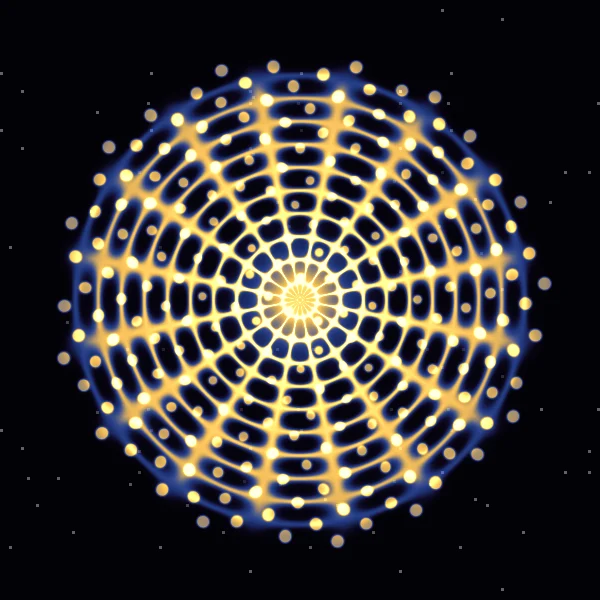
Abundance · 888 Hz · φ888 Hz + 1436.8 Hz (× φ) 888 Hz repeats the 8, the number numerology and Chinese culture link to prosperity, with its pair at φ and the Sunflower. The one the collection is named after.
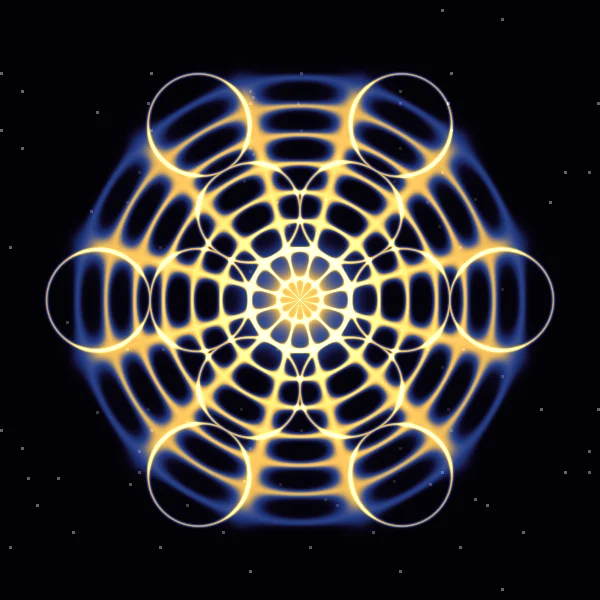
Prosper · 417 Hz · φ²417 Hz + 1091.7 Hz (× φ²) 417 Hz, the tone of change in the tradition, with its pair at φ² and the Fruit of Life. To move something that's been still for too long.
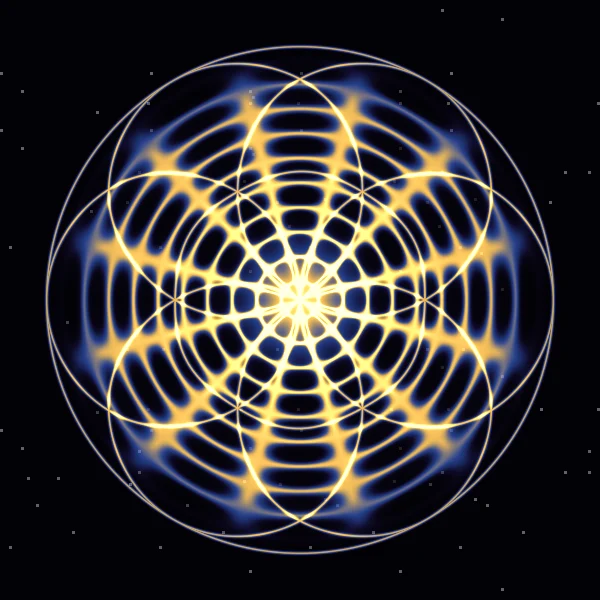
Gratitude · 639 Hz · φ²639 Hz + 1672.9 Hz (× φ²) 639 Hz, the heart, with its pair at φ² and the Seed of Life. To practice gratitude for what you already have.
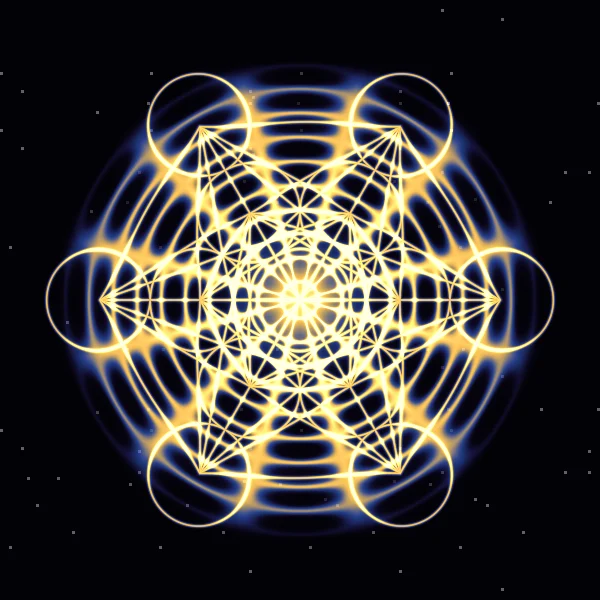
Vision · 852 Hz · φ³852 Hz + 3609.1 Hz (× φ³) 852 Hz, the third eye, with its pair at φ³, very high, and Metatron's Cube. To see clearly what you want before you go after it.
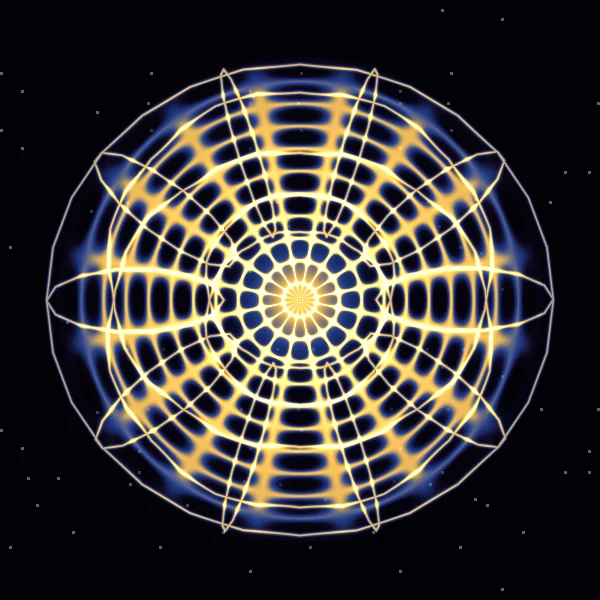
Open crown · 963 Hz · φ²963 Hz + 2521.2 Hz (× φ²) 963 Hz, the crown, with its pair at φ² and the Torus. To close your practice feeling whole.
Cymatica renders made with the app's own renderer: Mandala mode, Cosmos palette. In the app they move and sound.
A low tone, a high tone and φ between them.
Every preset in the collection joins two tones. The low one is a frequency from the tradition and plays in your left ear; the high one is that same frequency multiplied by φ (1.618…), the golden ratio, one or more times, and plays in your right ear.
In Manifest · 528 Hz · φ: 528 Hz on the left and 528 × φ = 854.3 Hz on the right.
On top of that, the app adds the golden ladder: the tones 528 × φⁿ above and below, between 30 and 4096 Hz, alternating ears and each step a little quieter, plus two air tones above at −12 dB. That's what the table shows.
Why it sounds like a spiral: φ is irrational, so no tone on the ladder lands on a harmonic of another and the waves never fully line up again. You don't hear a chord that settles, you hear a beat that turns slowly. XY mode shows the same thing: with φ, the Lissajous curve never closes.
| φⁿ | Hz | Ear | Level |
|---|---|---|---|
| φ⁻⁴ | 77.0 | left | −8 dB |
| φ⁻³ | 124.6 | right | −7 dB |
| φ⁻² | 201.7 | left | −6 dB |
| φ⁻¹ | 326.3 | right | −5 dB |
| φ⁰ | 528.0 | left · pair | 0 dB |
| φ | 854.3 | right · pair | 0 dB |
| φ² | 1382.3 | left | −6 dB |
| φ³ | 2236.6 | right | −7 dB |
| φ⁴ | 3619.0 | left | −8 dB |
| φ⁵ | 5855.6 | right · air | −12 dB |
| φ⁶ | 9474.6 | left · air | −12 dB |
Tab. 01 · Worked out by the app's own engine (cym.presets.js, ladderFreqs). Level in dB relative to the main pair; the player on this page approximates it without the app's room and noise bed.
Manifest · 528 Hz · φ, the pair and its ladder.
The sine waves of Manifest · 528 Hz · φ generated in your browser on the spot: 528 Hz on the left, 854.3 Hz on the right and the golden ladder around them. It fades in from silence and rises slowly. With headphones, each ear gets its own tone, as in the app.
Turn your volume down before you start. With headphones, lower still. If it bothers you at any point, stop.
Abundance and manifestation.
In the manifestation tradition, abundance starts with attention: knowing what you want, naming it and coming back to it every day. The frequencies anchor that time; the intention is yours.
528 Hz is the frequency of love and transformation in the Solfeggio tradition, which is why it opens the collection. 888 Hz repeats the 8 three times, the number numerology and Chinese culture link to prosperity. 417, 639, 852 and 963 Hz add change, gratitude, clarity and presence.
What Cymatica offers is a practice: five minutes to focus on what you want to build, with a sound to come back to and a shape to watch. In this tradition, abundance is what you do with that clarity.
Why people pick it.
- ·
Manifesting. Some people start the day with Manifest · 528 Hz · φ and one written sentence: what they want to build this month.
- ·
Gratitude. Before bed, Gratitude · 639 Hz · φ² and three things from the day to be grateful for.
- ·
Focus. Before a decision about work or money, Vision · 852 Hz · φ³ for a few minutes to see what you really want.
How to practice with the collection.
Coherent 5-5 breathing (in for 5 s, out for 5 s), five minutes, with Manifest or Abundance in Mandala.
Before you start, write one line about what you want to bring into your life: a project, a relationship, a change. While it plays, come back to that line every time your mind wanders. When you finish, write down one concrete step you can take today. The tradition calls it manifesting; in practice, it's focus.
What people ask about this collection.
Q1What is the abundance frequency?
The tradition names two above all: 528 Hz, the frequency of love and transformation in the Solfeggio series, and 888 Hz, for the 8 that numerology links to prosperity. In Cymatica both open the collection, each with its golden pair: 528 Hz with 854.3 Hz, and 888 Hz with 1436.8 Hz.
Q2Do frequencies attract money?
It's the most searched question, so let's be clear: the tradition talks about abundance as a form of attention (knowing what you want and acting in that direction), and no sound changes your finances on its own. What a daily practice does give you is time to focus. The frequencies are the anchor; the steps are yours.
Q3What is the golden pair?
A second tone: the first one multiplied by φ (1.618…) one or more times. In Manifest, 528 Hz plays in your left ear and 854.3 Hz in your right. With φ the two waves never fully line up again, which is why the sound turns slowly instead of standing still.
Q4Headphones or speakers?
Headphones, if you can: each ear gets its own tone, the low one on the left and the high one on the right, as it's meant to be. On speakers the tones blend in the air and still sound good, just without that separation. Always at low volume, below a conversation.
Q5Is it free?
All six are Pro. In the free version you can listen to a 30 second preview of each one (eight previews a day), and on this page the first one is ready to play, also for 30 seconds.