Solfeggio frequency · Solar plexus
528 Hz. See it and hear it.
528 Hz is the fifth of the nine Solfeggio frequencies and the best known: the tradition calls it the love frequency and links it to the solar plexus, the center. Musically it's a slightly sharp C5: the in-tune note sits at 523.25 Hz and 528 Hz is 16 cents sharp.
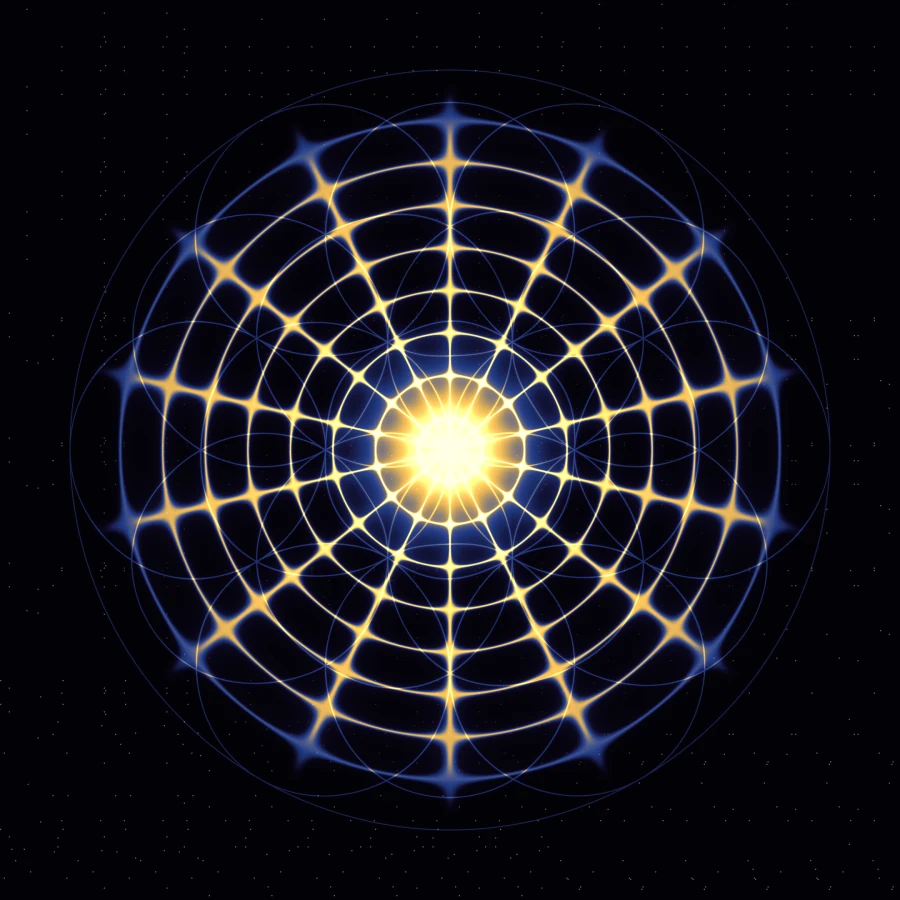
The shape of 528 Hz.
In Chladni it lands right on mode (14, 0): a regular grid of diamonds with the circles of the Flower of Life layer showing through. In Mandala, the image on this card, it's a web of straight spokes and concentric rings around a bright center, one of the most orderly in the series.
It's a Cymatica render, not an illustration: the same figure comes back every time you play 528 Hz.
Solar plexus, in the Solfeggio tradition.
In the Solfeggio tradition, 528 Hz is the frequency of love, transformation and repair. It sits at the center of the series, fifth of nine, and at the solar plexus, the center of the body on the map of the seven centers.
It's one of the six Joseph Puleo gathered in the mid-1970s. The modern tradition ties it to the syllable Mi in the hymn Ut queant laxis: "mira gestorum", the wonders of your works. That's why it's also called the miracle frequency.
The tradition looks at its numbers too: it's 111 Hz above 417 and 111 Hz below 639, and 5 + 2 + 8 = 15, and 1 + 5 = 6. Many people pick it as their everyday tone to meditate, and it's the one playing on Cymatica's home page.
528 Hz in figures.
| Frequency | 528.00 Hz |
|---|---|
| Nearest note (A = 440) | C5 |
| That note, in tune | 523.25 Hz |
| Deviation | 16 cents sharp |
| With A = 432 | C5 +47 ¢ |
| Plate mode in Chladni (n, m) | (14, 0) |
| In XY, against A | 1.200 = 6:5, just minor third; the curve closes |
| Wavelength in air | 65.0 cm |
| Period | 1.894 ms |
Tab. 01 · Note and cents worked out with equal temperament; a semitone is 100 cents. The plate mode and the XY ratio come from the app's own engine with the preset range (60 to 2600 Hz). Wavelength with sound at 343 m/s.
528 Hz, pure tone.
A 528 Hz sine wave generated in your browser on the spot: no recording, no compression, no music on top. It fades in from silence and rises slowly.
Turn your volume down before you start. With headphones, lower still. If it bothers you at any point, stop.
Why people pick it.
- ·
Meditating. It's a lot of people's everyday tone: five to ten minutes of coherent 5-5 or 4-7-8 breathing, with the intention of coming back to your center.
- ·
Studying. Some people leave it very low in the background during focus sessions. A tone with no beat and no lyrics doesn't ask for attention: it keeps you company without distracting you.
- ·
Resting. To close the day on a kind note: a few minutes lying down, at low volume, before sleep.
How to practice with 528 Hz.
Suggested practice
Coherent 5-5 or 4-7-8 breathing. Chladni mode, Sand palette, Flower of Life layer (free). 5 to 10 minutes. Intention: come back to your center.
What people ask about 528 Hz.
Q1What is 528 Hz used for?
In the Solfeggio tradition, 528 Hz is the frequency of love, transformation and repair, the solar plexus tone. People use it as an everyday tone to meditate, to focus or to close the day. What you see on this page is physics: the shape that tone draws, a web of spokes and rings in Mandala, the same every time. Cymatica is a listening and attention practice: it isn't a health product and doesn't replace care from a professional.
Q2Is it true that 528 Hz repairs DNA?
It's the most repeated thing about this frequency, so it's worth telling it straight. The idea took off in the late 1990s from the work of Leonard Horowitz and Joseph Puleo, who called 528 Hz the frequency of love and DNA repair. That's what the tradition claims, not a measured result: no solid study has shown it, and Cymatica doesn't promise it. What you can check here is something else: the shape it draws, how it sounds, and what you notice when you sit with it for five minutes.
Q3Pure tone or music?
What plays here is the pure tone: a single 528 Hz sine wave, no harmonics, no beat, no lyrics. It's the simplest thing you can listen to and the exact reference for the frequency. Many "528 Hz" tracks out there are music with that tone mixed underneath, or whole songs retuned: they're easier company for an hour, but they're no longer just 528 Hz. To practice while watching the shape, the pure tone is what draws it.
Q4Headphones or speakers?
Either works. Headphones shut the room out; speakers fill it. What matters is volume: low, below a conversation. Small phone speakers don't reproduce low frequencies well, so the lowest tones in the series (174 and 285 Hz) come through better on headphones. The pure tone isn't binaural: it sounds the same in both ears. The app's Binaural mode does need headphones.
Q5528 Hz or 432 Hz?
They don't compete: they're two different things. 432 Hz is a tuning, where you put the A and, with it, every other note; 528 Hz is one specific tone. With A = 440, 528 Hz sits near C5, 16 cents sharp; with A = 432, near {{NOTA_432}}, {{DESVIO_432}}. The app has both tunings: listen to both and keep the one your body asks for.
Q6Is 528 Hz good for sleep?
Some people listen to it for a few minutes before bed, very softly, as part of a wind-down routine. A short while with attention works better than a tone playing all night: after hours it stops keeping you company and turns into noise. If sleep is a regular struggle, talk to a professional.