Solfeggio frequency · Heart
639 Hz. See it and hear it.
639 Hz is the sixth of the nine Solfeggio frequencies: the tradition links it to the heart, the fourth center, and to relationships and connection with others. Musically it falls between two notes: it's 46 cents sharp of D#5 (622.25 Hz), almost a quarter tone.
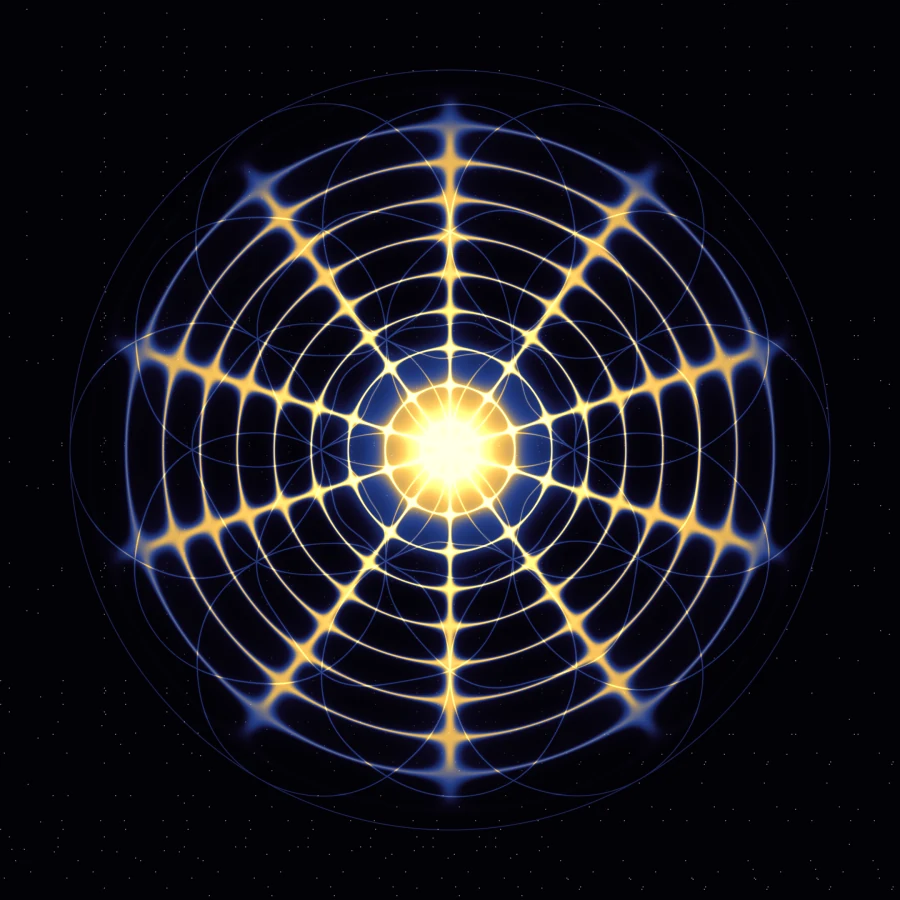
The shape of 639 Hz.
In Chladni it sits almost entirely in mode (14, 4), with a trace of (12, 8): curved lines that organize in two directions. In Mandala, a web of spokes and rings similar to 528.
It's a Cymatica render, not an illustration: the same figure comes back every time you play 639 Hz.
Heart, in the Solfeggio tradition.
In the Solfeggio tradition, 639 Hz is the heart, the fourth center, the one in the middle: relationships, connection and forgiving others.
It's one of the six Joseph Puleo gathered in the mid-1970s. The modern tradition ties it to the syllable Fa in the hymn Ut queant laxis: "famuli tuorum", your servants, the ones who sing together.
It's 111 Hz above 528, and 6 + 3 + 9 = 18, and 1 + 8 = 9. In Cymatica it's level 6 of the Path. Some people come back to it when there's something to forgive or someone to open up to.
639 Hz in figures.
| Frequency | 639.00 Hz |
|---|---|
| Nearest note (A = 440) | D#5 |
| That note, in tune | 622.25 Hz |
| Deviation | 46 cents sharp |
| With A = 432 | E5 −22 ¢ |
| Plate mode in Chladni (n, m) | between (12, 8) and (14, 4); the app blends them |
| In XY, against A | 1.452, no simple interval; the curve keeps turning |
| Wavelength in air | 53.7 cm |
| Period | 1.565 ms |
Tab. 01 · Note and cents worked out with equal temperament; a semitone is 100 cents. The plate mode and the XY ratio come from the app's own engine with the preset range (60 to 2600 Hz). Wavelength with sound at 343 m/s.
639 Hz, pure tone.
A 639 Hz sine wave generated in your browser on the spot: no recording, no compression, no music on top. It fades in from silence and rises slowly.
Turn your volume down before you start. With headphones, lower still. If it bothers you at any point, stop.
Why people pick it.
- ·
Meditating. With someone in mind: coherent 5-5 breathing for eight minutes and the intention of opening up to them.
- ·
Studying. Some people use it before a hard conversation, to arrive with a calmer pulse.
- ·
Resting. As a couple or a family, on speakers at low volume, watching the shape together.
How to practice with 639 Hz.
Suggested practice
Coherent 5-5 breathing. Mandala mode, Cosmos palette, Fruit of Life layer (Pro) or Flower of Life (free). 8 minutes. Intention: open up to someone.
What people ask about 639 Hz.
Q1What is 639 Hz used for?
In the Solfeggio tradition, 639 Hz is the frequency of the heart: relationships, connection and forgiving others. People use it to meditate with someone in mind, before a hard conversation or to share a calm moment. What you see on this page is physics: the shape that tone draws, the same every time. Cymatica is a listening and attention practice: it isn't a health product and doesn't replace care from a professional.
Q2Pure tone or music?
What plays here is the pure tone: a single 639 Hz sine wave, no harmonics, no beat, no lyrics. It's the simplest thing you can listen to and the exact reference for the frequency. Many "639 Hz" tracks out there are music with that tone mixed underneath, or whole songs retuned: they're easier company for an hour, but they're no longer just 639 Hz. To practice while watching the shape, the pure tone is what draws it.
Q3Headphones or speakers?
Either works. Headphones shut the room out; speakers fill it. What matters is volume: low, below a conversation. Small phone speakers don't reproduce low frequencies well, so the lowest tones in the series (174 and 285 Hz) come through better on headphones. The pure tone isn't binaural: it sounds the same in both ears. The app's Binaural mode does need headphones.
Q4639 Hz or 432 Hz?
They don't compete: they're two different things. 432 Hz is a tuning, where you put the A and, with it, every other note; 639 Hz is one specific tone. With A = 440, 639 Hz sits near D#5, 46 cents sharp; with A = 432, near {{NOTA_432}}, {{DESVIO_432}}. The app has both tunings: listen to both and keep the one your body asks for.
Q5Can you listen to 639 Hz as a couple or in a group?
Yes, and it's one of the most chosen for that. On speakers at low volume, each person with their own breathing. The shape on the screen gives everyone the same point to look at.