Intention collection · Soothing tones for healing and relief
Soothing frequencies. See them and hear them.
The Soothing tones for healing and relief collection brings together Cymatica's six lowest and calmest frequencies, from 89 to 210.42 Hz: Om, the Earth day, the Moon and the Sun as worked out by Hans Cousto, 111 Hz and 89 Hz, a Fibonacci number. Each one plays with a close golden pair, at φ or φ², which makes it the softest collection in the catalog.
Six frequencies, six figures.
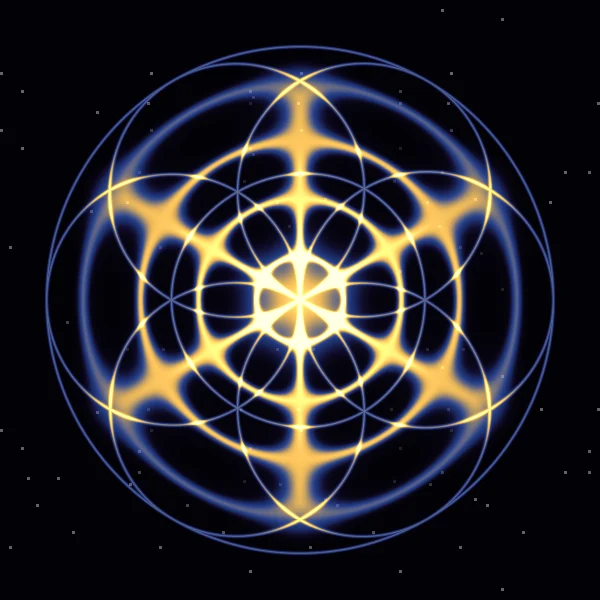
Soft · 89 Hz · φ89 Hz + 144.0 Hz (× φ) 89 Hz, a Fibonacci number, with its pair at φ, which lands on 144 Hz, the next number in the sequence, and the Seed of Life. Among the lowest in the catalog.
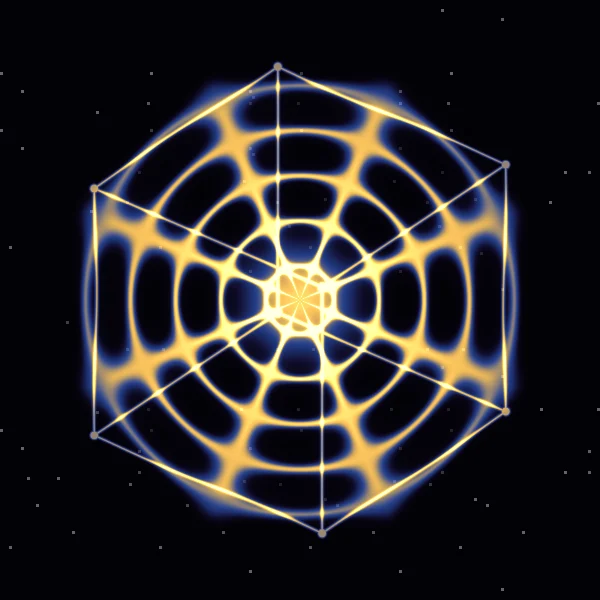
Earth · 111 Hz · φ²111 Hz + 290.6 Hz (× φ²) 111 Hz, the step that repeats through the Solfeggio series, with its pair at φ² and the Cube. To ground yourself.
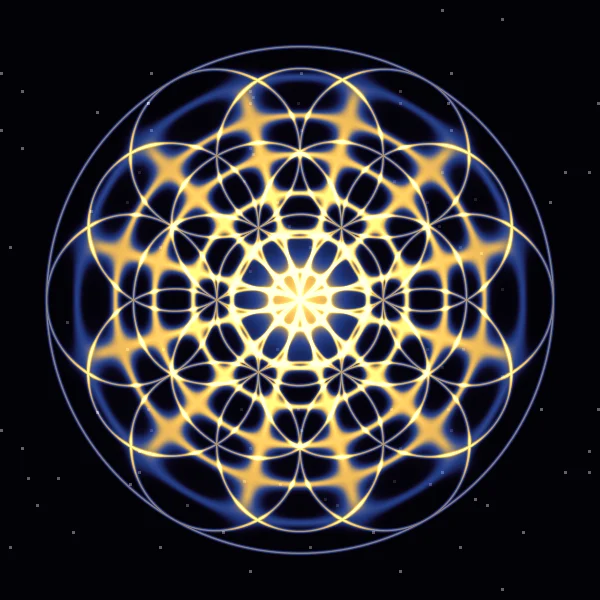
Soft Om · 136.1 Hz · φ136.1 Hz + 220.2 Hz (× φ) 136.1 Hz, Om, with its pair at φ and the Flower of Life. The soft version of the Om in the Healing and relief collection.
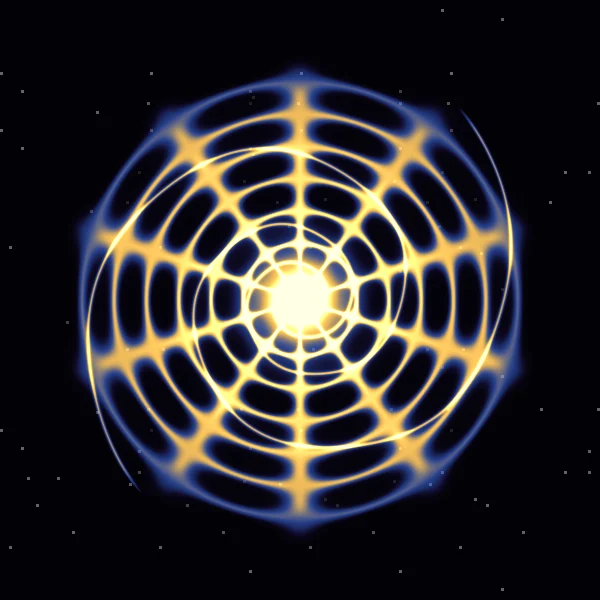
Moon · 210.42 Hz · φ210.42 Hz + 340.5 Hz (× φ) 210.42 Hz, the lunar month according to Hans Cousto, with its pair at φ and the Galaxy layer. For the night.
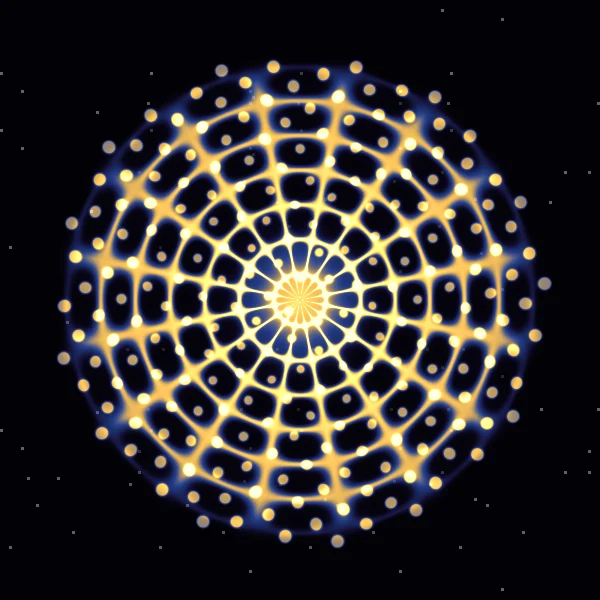
Day · 194.18 Hz · φ194.18 Hz + 314.2 Hz (× φ) 194.18 Hz, the Earth day according to Hans Cousto, with its pair at φ and the Sunflower. To start the morning slowly.
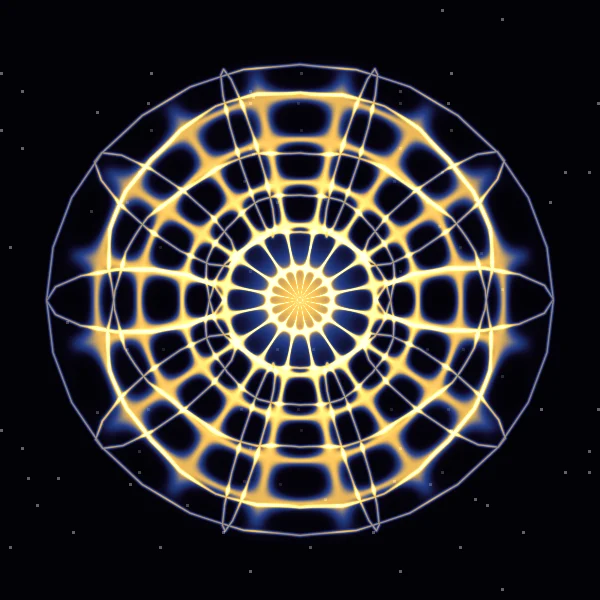
Sun · 126.22 Hz · φ²126.22 Hz + 330.4 Hz (× φ²) 126.22 Hz, the Sun tone according to Hans Cousto, with its pair at φ² and the Torus.
Cymatica renders made with the app's own renderer: Mandala mode, Cosmos palette. In the app they move and sound.
A low tone, a high tone and φ between them.
Every preset in the collection joins two tones. The low one is a frequency from the tradition and plays in your left ear; the high one is that same frequency multiplied by φ (1.618…), the golden ratio, one or more times, and plays in your right ear.
In Soft · 89 Hz · φ: 89 Hz on the left and 89 × φ = 144.0 Hz on the right.
On top of that, the app adds the golden ladder: the tones 89 × φⁿ above and below, between 30 and 4096 Hz, alternating ears and each step a little quieter, plus two air tones above at −12 dB. That's what the table shows.
Why it sounds like a spiral: φ is irrational, so no tone on the ladder lands on a harmonic of another and the waves never fully line up again. You don't hear a chord that settles, you hear a beat that turns slowly. XY mode shows the same thing: with φ, the Lissajous curve never closes.
| φⁿ | Hz | Ear | Level |
|---|---|---|---|
| φ⁻² | 34.0 | left | −6 dB |
| φ⁻¹ | 55.0 | right | −5 dB |
| φ⁰ | 89.0 | left · pair | 0 dB |
| φ | 144.0 | right · pair | 0 dB |
| φ² | 233.0 | left | −6 dB |
| φ³ | 377.0 | right | −7 dB |
| φ⁴ | 610.0 | left | −8 dB |
| φ⁵ | 987.0 | right | −9 dB |
| φ⁶ | 1597.0 | left | −10 dB |
| φ⁷ | 2584.1 | right | −11 dB |
| φ⁸ | 4181.1 | left · air | −12 dB |
Tab. 01 · Worked out by the app's own engine (cym.presets.js, ladderFreqs). Level in dB relative to the main pair; the player on this page approximates it without the app's room and noise bed.
Soft · 89 Hz · φ, the pair and its ladder.
The sine waves of Soft · 89 Hz · φ generated in your browser on the spot: 89 Hz on the left, 144.0 Hz on the right and the golden ladder around them. It fades in from silence and rises slowly. With headphones, each ear gets its own tone, as in the app.
Turn your volume down before you start. With headphones, lower still. If it bothers you at any point, stop.
Soothing tones for healing and relief.
Four of the six tones come from The Cosmic Octave, Hans Cousto's 1978 book: take a cycle in the sky and raise it octave by octave, doubling its frequency, until you can hear it. The Earth day gives 194.18 Hz; the year, 136.1 Hz, Om; the synodic lunar month, 210.42 Hz; and the Sun, 126.22 Hz.
The other two: 111 Hz, the step between almost all the Solfeggio frequencies, and 89 Hz, a number in the Fibonacci sequence, the one that converges on φ. Multiplied by φ, 89 gives 144, the next number in the sequence.
They're low, round tones, with no highs to grab your attention. The tradition uses them to slow down and keep rest company.
Why people pick it.
- ·
Relaxing. Some people play Soft Om · 136.1 Hz · φ when they get home, ten minutes, to change pace.
- ·
Background. Very low while you read, stretch or take a bath: they don't ask for attention.
- ·
Cycles. Day in the morning and Moon at night: some people use them to mark the start and the end of the day.
How to practice with the collection.
Coherent 5-5 breathing, five to fifteen minutes, lying down or seated. Play Soft Om or Moon at low volume and do nothing else: no intention, no goal, just listening and watching.
These are low tones: on headphones or an external speaker they sound much better than on a phone speaker.
What people ask about this collection.
Q1What are the most soothing frequencies?
The ones people pick most to relax are low and free of highs: 136.1 Hz, Om; 111 Hz; 174 Hz, the lowest of the Solfeggio tones; and 432 Hz, the natural tuning for many traditions. This collection gathers the lowest and softest in Cymatica's catalog. What relaxes most, in practice, is the time itself: low volume, slow breathing and nothing else to do.
Q2What are Hans Cousto's frequencies?
Hans Cousto, a Swiss mathematician and musicologist, published The Cosmic Octave in 1978: he takes cycles in the sky (the day, the year, the lunar month) and raises them octave by octave, doubling the frequency, into the audible range. The Earth day gives 194.18 Hz, the year 136.1 Hz and the synodic lunar month 210.42 Hz. The figures are exact calculations; their meaning comes from the tradition.
Q3What is the golden pair?
A second tone: the first one multiplied by φ (1.618…) one or more times. In Soft, 89 Hz plays in your left ear and 144.0 Hz in your right, two consecutive Fibonacci numbers. With φ the two waves never fully line up again, which is why the sound turns slowly instead of standing still.
Q4Why can I barely hear them on my phone?
Because they're low: the main tone runs from 89 to 210.42 Hz, and small phone speakers struggle below a few hundred hertz. On headphones or an external speaker they sound fine. Don't turn your phone up to compensate: switch speakers.
Q5Is it free?
All six are Pro. In the free version you can listen to a 30 second preview of each one (eight previews a day), and on this page the first one is ready to play, also for 30 seconds.