Solfeggio frequency · Root
396 Hz. See it and hear it.
396 Hz is the third of the nine Solfeggio frequencies and the first of the seven centers: the tradition links it to the root, to letting go of fear and guilt. Musically it's a slightly sharp G4: the in-tune note sits at 392.00 Hz and 396 Hz is 18 cents sharp.
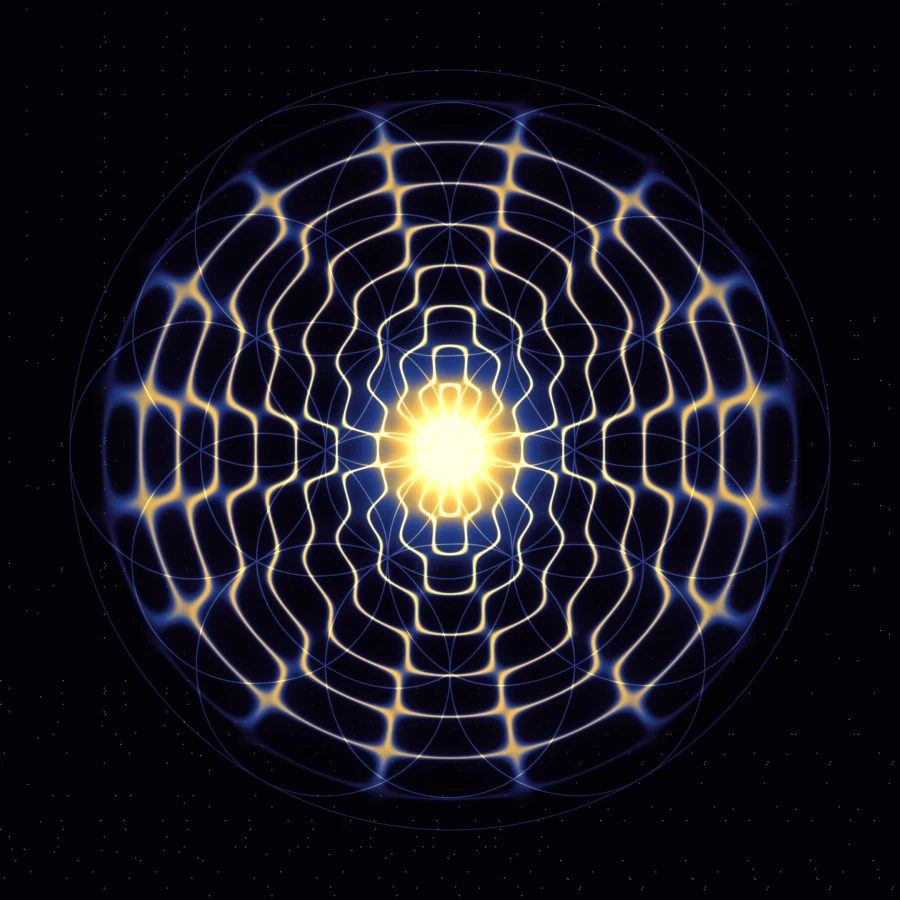
The shape of 396 Hz.
In Chladni it falls between two plate modes, (13, 0) and (11, 7), and Cymatica blends them: wavy curves with a strong diagonal. In Mandala, the rings ripple instead of closing into circles.
It's a Cymatica render, not an illustration: the same figure comes back every time you play 396 Hz.
Root, in the Solfeggio tradition.
In the Solfeggio tradition, 396 Hz is the root, the first energy center: grounding, letting go of fear and guilt.
It's one of the six frequencies Joseph Puleo gathered in the mid-1970s, the core of the series. The modern tradition ties it to the syllable Ut in the hymn Ut queant laxis, an 8th-century prayer to Saint John the Baptist that gave the notes their names (ut, re, mi, fa, sol, la). The link between that syllable and the number 396 comes from the tradition, not from an old score: nobody in the 8th century measured a tone in vibrations per second.
And the numbers: 3 + 9 + 6 = 18, and 1 + 8 = 9. In Cymatica it's level 3 of the Path. Some people come back to it when fear or insecurity tighten their grip.
396 Hz in figures.
| Frequency | 396.00 Hz |
|---|---|
| Nearest note (A = 440) | G4 |
| That note, in tune | 392.00 Hz |
| Deviation | 18 cents sharp |
| With A = 432 | G4 +49 ¢ |
| Plate mode in Chladni (n, m) | between (13, 0) and (11, 7); the app blends them |
| In XY, against A | 1.800 = 9:5, just minor seventh; the curve closes |
| Wavelength in air | 86.6 cm |
| Period | 2.525 ms |
Tab. 01 · Note and cents worked out with equal temperament; a semitone is 100 cents. The plate mode and the XY ratio come from the app's own engine with the preset range (60 to 2600 Hz). Wavelength with sound at 343 m/s.
396 Hz, pure tone.
A 396 Hz sine wave generated in your browser on the spot: no recording, no compression, no music on top. It fades in from silence and rises slowly.
Turn your volume down before you start. With headphones, lower still. If it bothers you at any point, stop.
Why people pick it.
- ·
Meditating. Seated, feet on the floor, box breathing 4-4-4-4: it's the grounding practice.
- ·
Studying. Before something daunting (an exam, a call, an interview), two minutes to get back into your body.
- ·
Resting. Lying down, feeling your body's weight on the floor or the bed while the tone plays low.
How to practice with 396 Hz.
Suggested practice
Box breathing 4-4-4-4. Chladni mode, Sand palette, Cube · Earth layer (Pro) or Flower of Life (free). 5 minutes. Intention: come back to your body.
What people ask about 396 Hz.
Q1What is 396 Hz used for?
In the Solfeggio tradition, 396 Hz is the frequency of the root: letting go of fear and guilt, grounding. People use it to meditate, to get back into their body before something daunting or to rest. What you see on this page is physics: the shape that tone draws, the same every time. Cymatica is a listening and attention practice: it isn't a health product and doesn't replace care from a professional.
Q2Pure tone or music?
What plays here is the pure tone: a single 396 Hz sine wave, no harmonics, no beat, no lyrics. It's the simplest thing you can listen to and the exact reference for the frequency. Many "396 Hz" tracks out there are music with that tone mixed underneath, or whole songs retuned: they're easier company for an hour, but they're no longer just 396 Hz. To practice while watching the shape, the pure tone is what draws it.
Q3Headphones or speakers?
Either works. Headphones shut the room out; speakers fill it. What matters is volume: low, below a conversation. Small phone speakers don't reproduce low frequencies well, so the lowest tones in the series (174 and 285 Hz) come through better on headphones. The pure tone isn't binaural: it sounds the same in both ears. The app's Binaural mode does need headphones.
Q4396 Hz or 432 Hz?
They don't compete: they're two different things. 432 Hz is a tuning, where you put the A and, with it, every other note; 396 Hz is one specific tone. With A = 440, 396 Hz sits near G4, 18 cents sharp; with A = 432, near {{NOTA_432}}, {{DESVIO_432}}. The app has both tunings: listen to both and keep the one your body asks for.
Q5What does 396 Hz have to do with the hymn Ut queant laxis?
The 8th-century hymn starts each line one note higher, and its opening syllables gave the notes their names: ut, re, mi, fa, sol, la. The modern Solfeggio tradition assigns a frequency to each syllable, and Ut gets 396 Hz. It's the tradition's reading: the hymn doesn't mention hertz.