Natural tuning · A = 432
Miracle tone432 Hz
432 Hz is the miracle tone, the natural tuning: the A that breathes with the body. It's the central A tuned to 432 instead of 440, and every other note comes down a little with it. In today's tuning it sounds like an A4 32 cents flat; with A = 432 it's exactly A4.
432Hz
Natural tuning · A4 −32¢
432 Hz, pure tone.
A pure 432 Hz tone, the simplest wave there is, generated in your browser on the spot: no recording, no compression, no music on top. It fades in from silence and rises slowly.
Turn your device volume down before you start and raise it little by little. Pure tones tire the ear more than music does. If you notice ringing, buzzing or discomfort, stop.
Safe volume: the signal never goes above −12 dBFS. How loud it reaches your ears is set by you, on your device.
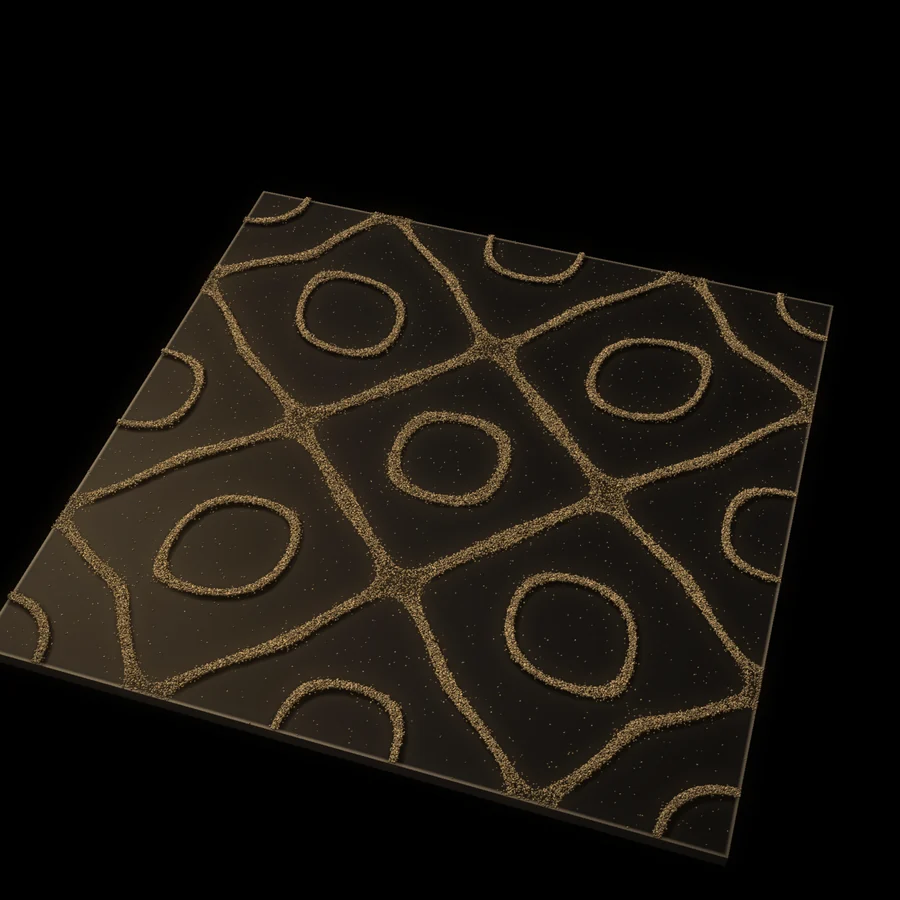
The shape of 432 Hz.
In Sand mode the plate answers with its natural 440 Hz figure, mode (8, 4): lines curve around a central ring. It's the same main figure that 417 Hz and the 440 A form: between 432 and 440 the difference is heard more than it's seen. In the app, the Notes · A=432 group and the A = 432 tuning let you compare the two.
It's a Cymatica render, not an illustration: the same figure comes back every time you play 432 Hz.
Natural tuning, A = 432.
432 Hz is the tuning of calm: high vibration, the tone you come back to when you want to rest. Many traditions call it natural tuning, and many people feel it warmer and rounder than 440.
It comes from a simple sum: if middle C is 256 Hz, a power of 2, and you tune in pure fifths, A lands exactly on 432. Verdi argued in 1884 for setting A at 432, and the 1955 international standard settled on 440. The full story is in the article 432 Hz vs 440 Hz.
In Cymatica it's called The One, the origin of sacred geometry, and it also plays in Night, inside the collection for sleep. Listen to it alone, with rain underneath, or as the tuning of the whole app.
432 Hz in figures.
Tab. 01 · The note comes from piano tuning (equal temperament): from one note to the next there are 100 cents. The plate shape and the XY curve are worked out by the app itself, with the range of its presets (60 to 2600 Hz). The wave size assumes sound at 343 m/s, in the air of a room.
432Hz
Frequency
A4
Nearest note (A = 440) · 32 cents flat
440.00 Hz
That note, in tune
A4
With A = 432 · in tune
(8, 4)
Shape it forms on the plate (Chladni)
1.964
XY curve, next to A
79.4cm
Size of the wave in the air
2.315ms
How long one vibration lasts
In the app
Pro. Try it in full with 7 days of Pro.
Why people pick it.
✓ Resting
It's the frequency of the night: at low volume, with rain sounds for sleep or brown noise underneath, to close the day.
✓ Meditating
Coherent 5-5 breathing and a tone that doesn't push: the intention of resting in your own rhythm.
✓ Playing and producing
Some people tune their instrument or session to A = 432 and compare: the app has all twelve notes in both tunings.
How to practice with 432 Hz.
Suggested practice
Breathe
Coherent 5-5 breathing.
Set up the shape
Water mode, Amber palette, no layer.
Set your intention
rest in your own rhythm.
What people ask about 432 Hz.
Q1What is 432 Hz used for?
432 Hz is the miracle tone and the natural tuning: people choose it to rest, meditate, sleep and play music with a warmer A. The figure you see on this page is formed by that tone on the plate, mode (8, 4), the same every time. Cymatica is a listening and attention practice: it isn't a health product and doesn't replace care from a professional.
Q2What's the difference between 432 Hz and 440 Hz?
They're two tunings of the same A. 440 Hz has been the international standard since 1955; 432 Hz is the natural tuning, about 32 cents lower, less than a third of a semitone. You can hear it if you play them back to back, and on the plate they form the same main figure. In the app you can switch from one to the other and hear all twelve notes in each.
Q3Pure tone or music?
What plays here is the pure tone: a single clean 432 Hz wave, no harmonics, no beat, no lyrics. Many "432 Hz" tracks are music retuned to A = 432: they're good company for a long listen, but they're no longer a single tone. To practice while watching the shape, the pure tone is the one that creates it.
Q4Headphones or speakers?
Either works. Headphones help you turn inward; speakers fill the room. The key is volume: low, below a conversation.
Q5432 Hz or 528 Hz?
They complement each other. 432 Hz is a tuning and the frequency of calm; 528 Hz is one specific tone, the love frequency. Some people start the day with 528 and close it with 432. Listen to both and keep the one your body asks for.
Q6Can I listen to 432 Hz for sleep?
Yes: it's the frequency of Night, in the collection of frequencies for sleep. In the app's Sounds you put it under rain, the sea or brown noise, with a timer and a black screen, all night long. If sleep keeps slipping away from you, talk to a professional.